
An Employer Guide to Preventing AI and Candidate Fraud (The Easy Way)
Effective strategies to combat AI candidate fraud in hiring. Learn how a robust verification processes can help protect your organization, the easy...
Making screening easy for candidates
.svg)
With Verified Credentials' mobile-first candidate experience, you meet candidates where it's most convenient. Learn how easy we make it.
Featured resource
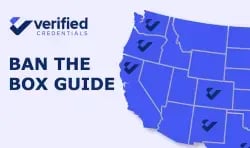
Our new Ban the Box Guide makes it easier than ever to decipher the patchwork of fair chance laws across the country. Check the map to quickly identify what laws apply to you.

Verified Credentials is proud to be accredited by PBSA and an original founding member. Our accreditation confirms that our policies, processes, and team member training meet rigorous industry compliance standards.
4 min read

Along with the rest of the workforce, adopting AI in screening and onboarding has become part of HR and hiring professionals' routine, too. We previously covered ways to prevent candidate fraud through screening, but today we want to cover AI on the other end of the table. While automation and AI agents can help speed up the screening and hiring process, keeping a human touch at the center can help protect quality and trust in a market where candidates are growing more skeptical of AI and impersonal automation.
What some employers don’t realize is that careless automation and AI use can lead to candidate mistrust. According to a recent SHRM study, 65% of HR professionals who use AI in recruiting use it to create job descriptions, and 33% use it to review or screen applicants. Gartner estimates that over half of candidates assume AI screens their applications, and only 26% trust AI to evaluate them fairly. That’s a significant gap in trust.
First impressions matter, and with the right level of human involvement throughout the process, you can strengthen your talent pool, improve hiring outcomes, and enhance your brand reputation.
You may already have fully embraced AI in your workplace, and we aren’t here to tell you to abandon it. Using AI in your hiring process offers multiple benefits, but it's important to remember that more isn’t always better.
In some cases, AI can reduce the likelihood of human error and bias, ensuring more consistent and objective evaluations based on objective criteria. AI-driven processes can also lead to significant cost savings compared to traditional background checks. By analyzing and implementing repetitive logic-based tasks quickly at scale, companies can allocate resources more efficiently, speed up processes, and reduce overhead.
What AI doesn’t always fully understand is discrimination and nuance that deviate from typical outcomes. With the growing number of laws and regulations governing AI, it is becoming clear that, in many cases, employers are responsible for outcomes, regardless of where the information comes from or whether a human was aware that a machine made a mistake.
Consistency is key to maintaining fairness in the hiring process and ensuring that all candidates are assessed equally. While AI is famous for doing more in less time, its cost-effectiveness erodes when mistakes go unnoticed.
Clear communication about the use of AI in candidate screening is often overlooked, especially in states where transparency about AI usage is mandated by law. Providing candidates and employees with information on how decisions are made helps build trust, transparency, and accountability.
As AI grows in popularity, unsurprisingly, new government announcements and laws have followed. It's important to stay current and consider relevant guidelines and state-specific regulations when using AI for screening. Here are a few recent examples:
**Disclaimer: Always consult your legal counsel when making a hiring or employment decision, and plan to use AI for your unique hiring situation, especially where state and federal regulations apply. The states listed in this article are not the only states with AI regulations. This post is for informational and educational purposes only and does not constitute professional legal advice.
While AI can handle many tasks efficiently, human judgment is critical. AI can and will make errors. Fast response times and quicker screening are only helpful if they are accurate, fair, and adequately address candidate needs.
When decisions are almost fully automated with little to no human intervention, transparency can break down quickly. Most candidates already automatically assume that AI is involved in hiring at some stage, and with no clear, transparent human checkpoints, trust can erode quickly. Communicating clearly with candidates throughout the screening and hiring process lays a foundation that can build trust and help your hiring team land top talent.
AI tools can make great assistants, but even well-designed systems can produce false positives, mismatches, or an incomplete picture of candidates. Regular human oversight and involvement reinforce the idea that people are behind the scenes, monitoring the process.
One alternative to fully leaning on automated systems to save time is to integrate your screening process with your hiring and onboarding systems. Integrating hiring and screening software can help your hiring team see everything in one place, create a better onboarding experience, and help reduce errors and discrepancies by using candidate-supplied information.
Especially as regulations and accountability for automated systems increase, screening is a critical part of hiring and onboarding that requires human oversight. Efficiency without oversight isn’t efficient, and background screening that your business and candidates can trust is pivotal.
Human review protects trust, strengthens fairness, and ensures efficiency without compromising compliance checkpoints or the candidate experience. With Verified Credentials, that oversight is built into the screening process by design, making it easier than ever to apply human intervention where it matters most. Our team of verification specialists reviews queues, escalation paths, and decision checkpoints to ensure human judgment is applied consistently and efficiently.
To learn more about our verifications team and process, take a look here. If you are interested in learning more about partnering with Verified Credentials, get started here.
The content above is for informational purposes only. Please consult with your legal counsel before selecting a background screening provider.
.png)
Effective strategies to combat AI candidate fraud in hiring. Learn how a robust verification processes can help protect your organization, the easy...

The Verified Credentials team was fortunate to attend SHRM National 2025, where we learned about what is expected from HR professionals in 2025 and...

Discover the essentials of employment background screening, including types of checks, information collected, and the factors that influence results.